Love or Arranged Marriage Calculator
The love or arranged marriage calculator is a free marriage prediction tool that analyzes your date of birth across four factors (Independence, Family Orientation, Romantic Initiative, and Timing Readiness) and maps the result onto a spectrum between love and arranged marriage. Enter your birth date below to see where your chart leans, whether love marriage, arranged marriage, or a balanced blend of both.
Runs in your browser, so nothing is sent or stored.
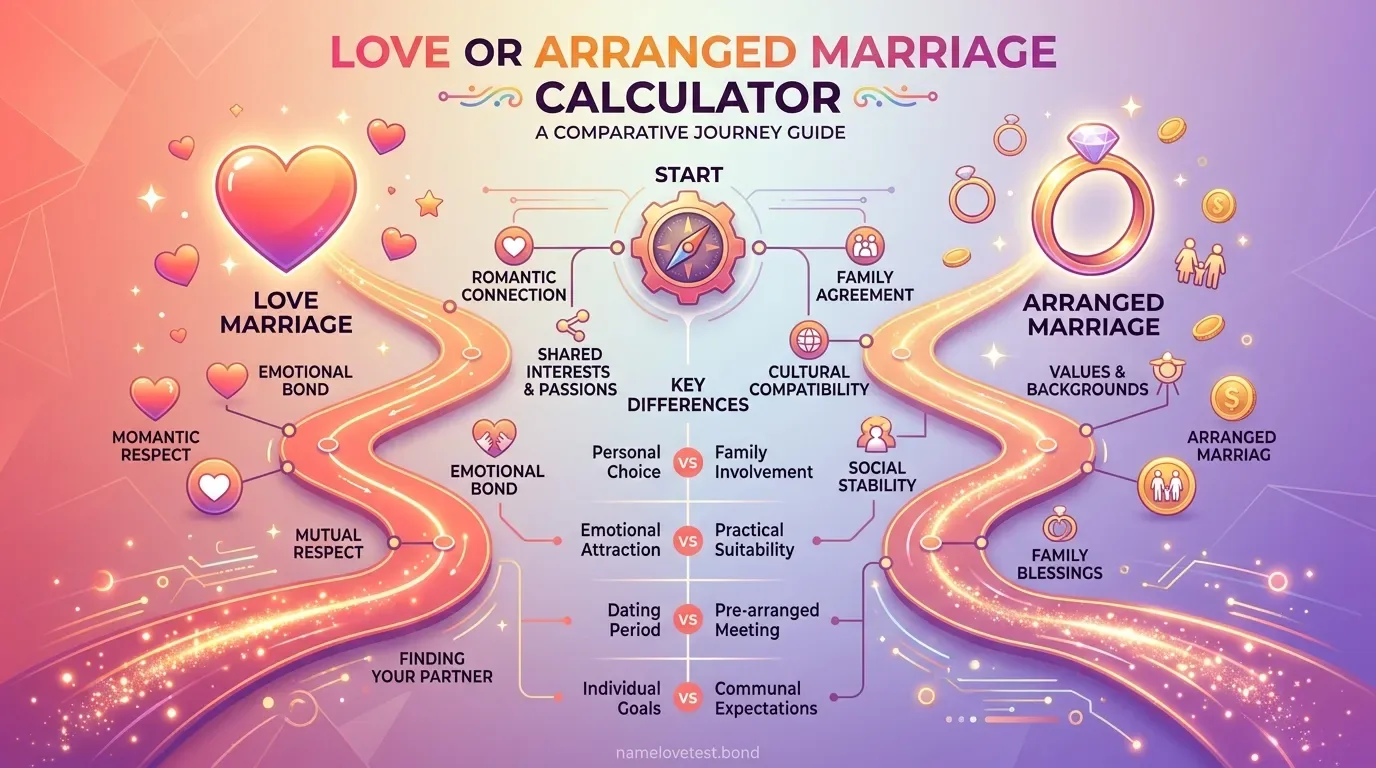
What Is a Love or Arranged Marriage Calculator?
A love or arranged marriage calculator is an online marriage prediction tool that analyzes birth date patterns and maps them onto a love to arranged spectrum. While exploring relationship dynamics, you can always run a quick general compatibility check first using our core name tester. The tool takes a single date of birth, extracts numerical signals (month, day, weekday, digit composition), scores each signal against a compatibility model inspired by Vedic astrology and numerology, and produces a marriage prediction ranging from "Strongly Arranged" to "Strongly Love", with a balanced middle zone for family-accepted love marriages.
How Does the Love vs. Arranged Marriage Calculator Work?
The love vs. arranged marriage calculator works by extracting 4 numerical signals from a birth date, scoring each signal against a pattern model, and blending the results into a single position on the love to arranged spectrum. Here is the step by step process:
Independence
Measures self directed choice tendency. Derived from odd/even day patterns, prime-number days, and the digit composition of the full birth date. Higher independence scores push the result toward the love marriage end of the spectrum.
Family Orientation
Evaluates how strongly family-oriented energy appears in the birth month and seasonal cycle. Certain months carry stronger traditional-gathering associations. Higher family orientation scores push the result toward the arranged marriage end.
Romantic Initiative
Scores the birth date's alignment with patterns associated with romantic self selection. Digit roots and day-of-week influences map to romantic inclinations. Inspired by the 5th house (romance) in Vedic astrology and Venus-Moon combinations.
Timing Readiness
Analyzes cyclical and seasonal patterns from the birth date that suggest openness to different marriage paths. Based on seasonal energy, day-of-month phase, and marriage timing patterns from the 7th house (spouse and partnerships) in Vedic astrology.
How to Use the Love or Arranged Marriage Calculator
To use the love or arranged marriage calculator, follow these 4 simple steps. The process takes under 10 seconds and works on any device.
Enter Your Date of Birth
Select your birth date using the date picker. Enter the correct day, month, and year. The algorithm handles leap year birthdays (February 29) without issues. Birth time is not required: the calculator works with dates only.
Add Your Name (Optional)
Type your full name in the optional name field. Adding a name provides a subtle refinement through vowel-ratio analysis. Alternatively, for a much simpler take, some couples just compare the first letters of their names before checking marriage tendencies. The core marriage prediction works without a name; the tool shows a confidence indicator ("full" with name, "partial" without) so you always know what inputs were used.
Click "Reveal Your Chart"
Press the Calculate button. The algorithm processes your date of birth in a fraction of a second (extracting day patterns, month signals, digit roots, and seasonal cycles) and produces a marriage prediction with a single click.
View Your Marriage Prediction
See your position on the love to arranged gradient spectrum with an animated indicator. Read the verdict (Love Marriage, Arranged Marriage, or Balanced/Love-cum-Arranged), review the 4-factor breakdown with bar charts, and open "See how this was calculated" for the full step by step methodology. Use the action buttons to copy a share link or start a new calculation.
Who Is This Love or Arranged Marriage Calculator For?
The love or arranged marriage calculator serves 6 types of users, from curious individuals to couples and astrology enthusiasts:
Singles curious about marriage path
Individuals wondering whether their personality and birth date patterns lean toward love marriage or arranged marriage. The calculator gives a quick, fun answer based on numerology and Vedic-inspired factors.
Couples exploring compatibility
Partners who want to compare their individual marriage tendencies side by side. Each partner runs the calculator separately and compares spectrum positions to discuss differences in independence, family orientation, and romantic initiative.
Astrology and numerology enthusiasts
People interested in Vedic astrology, birth chart analysis, life path numbers, and planetary influences (Venus, Mars, Jupiter). The transparent methodology connects date-of-birth patterns to concepts from the 5th house and 7th house.
Friends and family at gatherings
Groups looking for a light, entertaining activity at parties, weddings, or family events. The shareable results and quick calculation (under 10 seconds) make the tool a conversation starter about marriage preferences.
Self awareness seekers
People using the results as a starting point for self reflection about values, independence, and family dynamics. The 4-factor breakdown provides specific talking points about personality traits and tendencies.
Content creators and bloggers
Writers covering marriage astrology, love marriage vs arranged marriage, or relationship topics. The calculator provides shareable, interactive content that audiences can try themselves.
Factors That Influence Your Marriage Type
Marriage type (love marriage, arranged marriage, or a blend of both) is influenced by 8 factors that span personality, family, culture, and astrology. The love or arranged marriage calculator captures 4 of these through birth date analysis. The remaining 4 are real life factors no algorithm can measure.
4 Factors the Calculator Measures
4 Real Life Factors Beyond Any Calculator
Pros and Cons of Love Marriage
Love marriage, where two people choose each other based on mutual affection, romantic chemistry, and emotional understanding, has 5 clear advantages and 5 common challenges:
5 Pros of Love Marriage
- Existing emotional bond: Partners already know each other's personality, communication style, and compatibility before the wedding.
- Mutual understanding from day one: Trust, empathy, and emotional support are established during courtship, reducing the adjustment period after marriage.
- Freedom of choice: Both individuals select their partner based on personal connection, shared values, and romantic chemistry rather than external factors.
- Stronger communication foundation: Couples who date before marriage develop conflict resolution skills and learn to handle ups and downs together.
- Higher initial satisfaction: The emotional attachment and passion present at the start of a love marriage contribute to early relationship satisfaction.
5 Cons of Love Marriage
- Family opposition risk: Parents and extended family may resist the match, creating emotional strain, especially in cultures where parental approval holds weight.
- Social pressure and inter caste hurdles: Community expectations around caste, religion, and social status can create obstacles for love marriage couples.
- Idealized expectations: The intensity of romantic love sometimes creates unrealistic expectations that are difficult to sustain after the initial excitement fades.
- Financial planning gaps: Couples who marry for love sometimes underestimate the practical aspects (finances, living arrangements, career alignment) that arranged marriage setups typically address upfront.
- One sided commitment risk: Love marriages carry the risk of mismatched commitment levels, where one partner may be more invested than the other, leading to instability.
Pros and Cons of Arranged Marriage
Arranged marriage, where family members identify, evaluate, and recommend a partner based on compatibility criteria including horoscope matching, family background, and shared values, has 5 clear advantages and 5 common challenges:
5 Pros of Arranged Marriage
- Family support from the start: Both families invest in the marriage's success, providing emotional, financial, and practical support throughout the relationship.
- Compatibility screening upfront: Family members evaluate education, career, financial stability, health, and horoscope compatibility (Kundali matching, Gana Koota, Graha Maitri) before introduction.
- Lower social friction: Arranged marriages typically align with cultural, religious, and community expectations, reducing external opposition and societal backlash.
- Structured decision-making: The arranged marriage setup provides a framework for evaluating multiple marriage prospects systematically rather than relying on chance meetings.
- Growing love over time: Research suggests that satisfaction in arranged marriages tends to increase over time as partners develop deeper emotional understanding and commitment.
5 Cons of Arranged Marriage
- Limited pre marriage bonding: Partners often have restricted time and interaction before the wedding, making it harder to assess true compatibility.
- Pressure to conform: Family expectations around dowry, social status, and traditional gender roles can override individual preferences and personal growth.
- Adjustment challenges: Living with a person you did not choose requires significant emotional adjustment, and misunderstandings are common in the early months.
- Fear of commitment to a stranger: The uncertainty of marrying someone you barely know can cause anxiety and fear of commitment, especially for individuals with high independence values.
- Risk of prioritizing family over compatibility: Arranged marriage setups sometimes prioritize family reputation, financial match, and horoscope alignment over genuine personality compatibility between the two individuals.
Success Rates: Love Marriage vs. Arranged Marriage
Comparing love marriage and arranged marriage success rates requires context, because divorce rates, satisfaction levels, and cultural attitudes vary across regions. Here are the available data points from different sources:
Love Marriage
Arranged Marriage
Context matters: Low divorce rates in arranged marriages often reflect social stigma against divorce and family pressure to stay married rather than higher relationship quality. Satisfaction data varies across studies and regions. Both love marriages and arranged marriages succeed when partners invest in communication, trust, emotional support, and personal growth. No marriage type guarantees a healthy relationship; the effort both partners invest is the strongest predictor of success.
Frequently Asked Questions
What does 'Love Cum Arranged' mean?
'Love cum arranged' is a widely used term in South Asian cultures for a marriage that blends elements of both love and arranged paths. The couple meets and develops a romantic connection on their own, but family involvement and parental approval play a role in formalizing the marriage. This balanced approach combines personal choice with family blessing, and many people land in this zone on the love to arranged spectrum. The love or arranged marriage calculator maps birth date patterns to this same spectrum, including the balanced middle range.
Which is better: love marriage or arranged marriage?
Neither love marriage nor arranged marriage is universally better; both paths lead to successful relationships when built on communication, trust, and commitment. Love marriages offer the advantage of an existing emotional bond and mutual understanding between partners before the wedding. Arranged marriages offer the advantage of family support, compatibility matching through Kundali analysis, and lower social pressure in cultures where arranged setups are traditional. The success of any marriage depends on the effort both partners invest, not the method of partner selection.
Do love marriages have higher divorce rates than arranged marriages?
No single global statistic covers all cultures and regions. In India, arranged marriages report lower divorce rates (estimated 1% to 3%) compared to love marriages, but this number reflects social pressure against divorce rather than higher relationship satisfaction. In Western countries, where most marriages are love based, divorce rates range from 35% to 50%. Comparing these numbers directly is misleading because cultural attitudes toward divorce, family involvement, and legal frameworks differ across regions. Both marriage types succeed when partners maintain communication, emotional support, and mutual respect.
Can this calculator be used for compatibility with a specific partner?
No, this version of the love or arranged marriage calculator analyzes one person's birth date patterns at a time. The tool maps individual traits (independence, family orientation, romantic initiative, and timing readiness) onto a love to arranged spectrum. For couple compatibility with a specific partner, use the Love Calculator by Date of Birth, which takes two birth dates and produces a 4-dimension compatibility score between two people.
Is this based on real Vedic astrology?
The love or arranged marriage calculator is inspired by Vedic astrological concepts: the 5th house (romance), 7th house (marriage and spouse), planetary influences of Venus, Mars, and Jupiter, and birth chart analysis. The tool does not perform a real Kundli or Guna Milan calculation because those require precise birth time, birth location, and access to a Swiss Ephemeris for planetary positions. The 4 factors used in this calculator (Independence, Family Orientation, Romantic Initiative, Timing Readiness) are original interpretations based on date-of-birth numerology, not traditional Vedic calculations.
Is this appropriate for all cultures?
The concept of love marriage versus arranged marriage is most culturally relevant in South Asian, Middle Eastern, and certain East Asian contexts where both marriage paths are common. In Western cultures where arranged marriages are rare, the tool still provides value as a personality-style reading about independence versus family orientation, romantic initiative versus traditional values. The calculator was designed with the South Asian cultural context in mind but works for anyone curious about where their birth date patterns land on the love to arranged marriage spectrum.

About the Author
Robert BrownRobert Brown has been writing about relationships and personality psychology for over 5 years, having personally taken and reviewed 100+ compatibility tests. With a strong background in content writing, relationship coaching, and numerology, he built Name Love Test to bring transparency to black-box compatibility sites. Robert's insights on compatibility and interpersonal connections have been cited by leading lifestyle platforms, and he actively shares his expertise with a growing social community dedicated to exploring relationship dynamics.