Name Love Test
Enter two names and get an instant love score, plus the five factors behind the number. A name love test analyzes letter patterns, numerological values, and phonetic rhythm between two names to produce a compatibility score from 0 to 100 percent. Put your names to the test, compare pairs, and share your result in seconds, directly in your browser.
Runs in your browser, so names never leave your device.
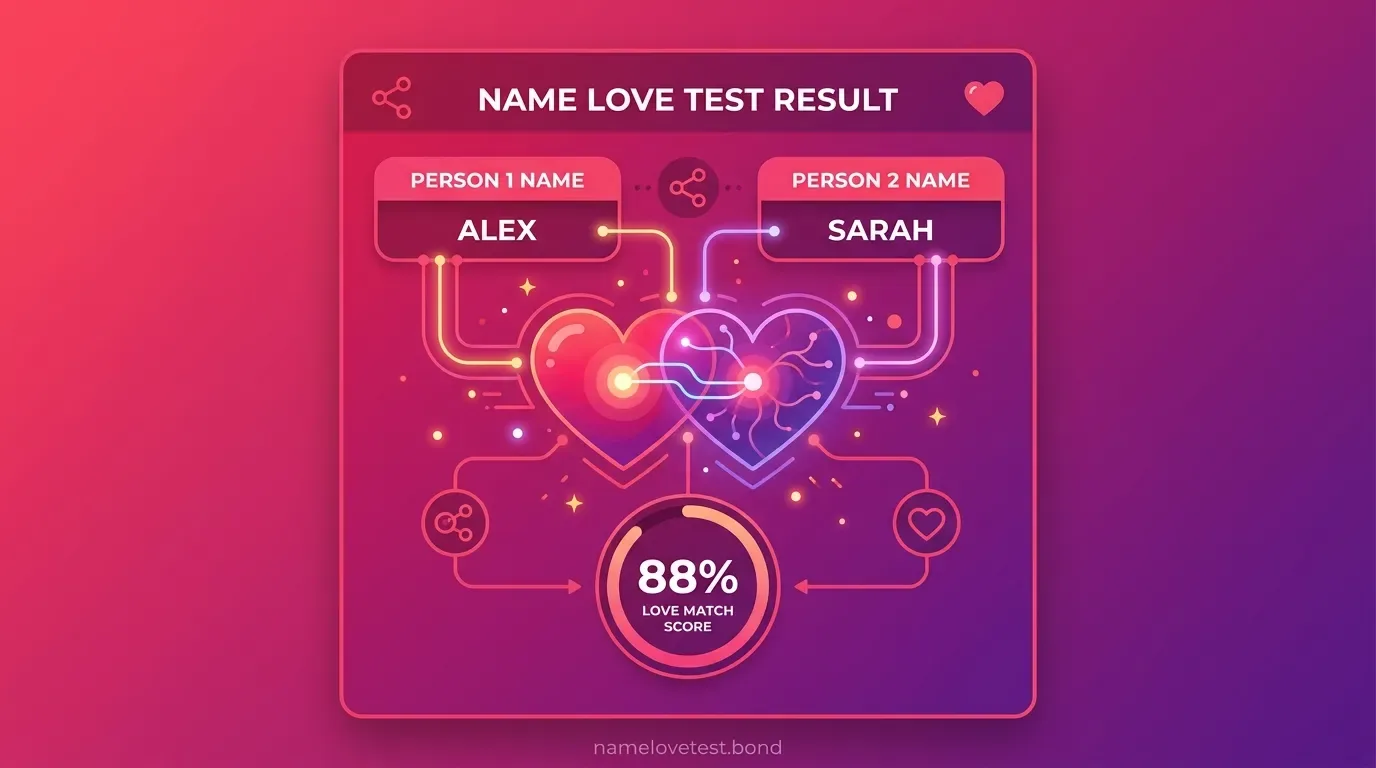
What Is a Name Love Test?
A name love test is a compatibility tool that analyzes two names and returns a love percentage based on letter patterns, numerology, and phonetic properties. The same concept appears under different names (including Love Calculator, Love Meter, Love Percentage Calculator, True Love Calculator, and Name Compatibility Test), but the core idea stays the same: enter two names, get a score. And whether you're curious what your birth dates reveal about your compatibility or want an instant test based on your names, exploring romantic connection has never been easier.
People have tested name compatibility for decades, from writing names on paper and counting matching letters in school to consulting fortune tellers, palmists, and astrologers in person. The name love test provides a modern digital alternative that is faster, free, and available directly in your browser on any device.
How the Name Love Test Works
The name love test on this page evaluates two names across five relationship factors: Letter Harmony, Number Pair, Sound and Cadence, Initials, and Balance. Each letter converts to a numeric value (1-9) using the Pythagorean system, and the tool compares digit roots, phonetic overlap, and letter frequency between both names. The result is a deterministic love score: the same two names always produce the same percentage, in either order.
The name love test is not scientifically proven to measure love compatibility. Real attraction depends on trust, communication, shared values, and physical chemistry, which are factors no algorithm can capture from two text fields. The tool is built for fun, reflection, and sharing, rather than making life decisions about a partner or a crush.
How to Use Our Name Love Test Tool (Step by Step)?
To use the name love test, follow these 5 steps:
Enter your name
Type your name in the first field. You can use a first name, full name, or nickname, because any format works. The tool accepts names in English, Hindi, Arabic, Korean, and 50+ other scripts.
Add the second name
Type your crush's name, partner's name, or any name you want to test. The name love test compares any two names, whether romantic, platonic, or simply out of curiosity.
Hit Calculate
Click the Calculate button. The 5-factor analysis runs in your browser and produces an instant result without page reloads, signups, or waiting.
Read your love score
The animated ring fills to your love percentage (32-98 range). Below the score: a verdict headline, a band label (Curious / Interesting / Warm / Strong / Exceptional), and a full 5-factor breakdown you can expand.
Share, compare, or try another pair
Copy the shareable link to send your result on WhatsApp, Instagram, or any app. Click "Test Another Pair" to run a new comparison. Your recent tests appear as history chips for quick replay.
The entire process of entering names, clicking Calculate, and viewing your score takes under 10 seconds. Some people prefer a quicker check using just their initials before analyzing complete names. Either way, the name love test runs entirely in your browser, so your entries never leave your device.
Can I Test Multiple Names?
Yes, you can use the "Test Multiple Names" tab in the tool above to enter your name once and compare it against up to 10 names at the same time. The tool scores every pair, ranks them from highest to lowest, and shows all results in a single table with medals for the top 3. No need to re-enter your name or run tests one by one.
There are 5 ways to test multiple names on this page:
Test Multiple Names
Switch to the "Test Multiple Names" tab, enter your name, add 2 to 10 names to compare, and hit "Compare All Scores." You get a ranked leaderboard with medals in one click.
Replay
Click "Test Another Pair" after any single-pair result to clear both fields and start fresh with new names.
History Chips
Your recent name pairs appear as clickable chips below the tool. Tap any chip to re-run that test instantly without retyping.
Share Links
Copy a shareable link for any result. Send the link to a friend or group chat, and the recipient sees the same score when the link opens.
Compare Scores
Whether you use multi-name mode or single-pair replay, compare love percentages side by side to see which name pair scores highest.
Common multi-test scenarios: enter your name and add 5 crushes to see who ranks #1, test your partner's nickname versus their full name, or run famous couples (such as Naruto and Hinata, Monica and Chandler, or Romeo and Juliet) as a party game in group chats, promposals, or on Valentine's Day.
What Does Your Love Percentage Say?
Every love score from the name love test falls into 1 of 4 percentage bands. Each band carries a label, a tone, and a one line verdict, though none of the four bands claim to predict a real relationship outcome.
Rare alignment across all 5 factors. About 1 in 20 name pairs lands here. The letters, numbers, rhythm, and initials all pulled in the same direction. Worth a screenshot.
Strong overlap in multiple dimensions. The name match score is above average, and the factor breakdown shows real patterns. Keep exploring, because your names share noticeable chemistry.
A mix of shared elements and contrast between the two names. Some factors align while others diverge, creating an engaging contrast between both names.
Your names take different paths through the alphabet. That difference is a data point, not a verdict. Real attraction, trust, and communication are built by people, not by letters.
The love percentage ranges from 32 to 98, so it is never 0% and never 100%. A 0% would be needlessly unkind (some users test a real partner's name while feeling anxious), and a 100% cheapens the scale. The calibration curve distributes scores so that high results stay rare and low results stay gentle. For those who enjoy nostalgic relationship games, the old school FLAMES method still holds up as a fun letter elimination pastime.
What Makes Up Your Love Score
The love score is a weighted composite of 5 factors. Each factor measures a real linguistic property of the two names.
Can Names Really Predict Love Compatibility?
No, names cannot predict love compatibility. No peer reviewed study has demonstrated that letter patterns, numerological values, or phonetic similarity between two names predict relationship outcomes. The name love test is a compatibility game, not a forecast, a diagnostic, or a replacement for consulting an expert or trusting your own judgment.
The psychology of why love test results feel personal is well studied. The Barnum effect (also called the Forer effect) describes how vague, positive statements feel uniquely applicable to us. Psychologist Bertram Forer demonstrated this effect in 1948, when students rated a generic personality description as highly accurate, believing it was written specifically for them. The same effect applies to love test verdicts: a warm, specific sounding sentence about "your names sharing an easy rhythm" feels meaningful because it describes an experience most people recognize.
What the Name Love Test Measures
- Letter frequency overlap between 2 names
- Pythagorean digit root compatibility (1-9)
- Vowel to consonant ratio similarity
- Alphabet proximity of initials
- Length balance between both names
What No Name Test Measures
- Real attraction or chemistry between people
- Trust, communication, or shared values
- Emotional availability or attachment style
- Whether your partner loves you back
- Long term relationship success or failure
Robert Sternberg's triangular theory of love identifies 3 components of love: passion, intimacy, and commitment. Gary Chapman's Five Love Languages framework describes 5 ways people express and receive affection: words of affirmation, quality time, physical touch, acts of service, and receiving gifts. Both frameworks measure behavior, emotion, and communication. Furthermore, if you're weighing a love match against a family arranged one, we've built a dedicated comparison tool to help reflect on how family expectations and personal chemistry interact.
The name love test is built for fun first. It blends numerology inspiration (Pythagorean letter values, digit roots) with linguistic pattern analysis (letter frequency, phonetic rhythm) to produce a number that feels personal. And for a deeper, number based reading of your match, exploring life path numbers and vowel vibrations offers another fascinating perspective. The result is an engaging conversation starter at parties, in group chats, on dates, or whenever curiosity strikes. Follow your heart, not a percentage.
Frequently Asked Questions
Is the Name Love Test 100% Accurate?
No, the name love test is not 100% accurate and no name based compatibility tool is scientifically proven to predict real relationships. The name love test is a curiosity-driven tool built for amusement only, analyzing letter patterns, numerological values, and phonetic rhythm between two names to produce a love score. Real compatibility depends on shared values, trust, and communication. Follow your heart, not a percentage.
Does the Order of Names Matter?
No, the order of names does not change the love score. The name love test uses a deterministic algorithm that sorts both names alphabetically before running any calculations. Enter Alex + Jenny or Jenny + Alex, the result stays the same every time. The input order has zero effect on your love percentage.
What Happens If I Test My Own Name Against Itself?
The name love test returns a special self love result instead of a score. Testing your own name against itself bypasses the scoring engine and displays a warm message about self compatibility. The tool does not output 100% for identical names because a perfect score would be meaningless, because every factor would match by default.
Can I Test Compatibility with a Crush's Name?
Yes, testing a crush's name is the most common use of the name love test. Enter your name in the first field and your crush's name in the second field, then hit Calculate. The tool produces a 0-100% love score with a 5-factor breakdown in seconds. The result is a lighthearted party game, not a decision-making tool, so have fun with the result and ask them out regardless.
Does the Name Love Test Work for Friends and Family Too?
Yes, the name love test works for any two names, such as romantic partners, friends, siblings, coworkers, or fictional characters and celebrities. The scoring algorithm analyzes linguistic properties of the two names (letter overlap, numerical roots, sound rhythm) without assuming a romantic context. Many people use the name love test in group chats, at parties, and during special occasions for fun.
Can I Retake the Test with Different Name Combinations?
Yes, retake the name love test as many times as you want with different name combinations. Each test takes seconds. The tool stores your recent tests as clickable history chips, so you can compare name pairs without retyping. Try 3 crushes, test your partner's nickname vs. full name, or run your parents' names; every replay is free and instant.
How Is the Love Score Calculated from Two Names?
The love score is calculated from two names using 5 weighted factors: Letter Harmony (30%) counts shared letters between names, Number Pair (25%) converts each letter to a number (1-9) using the Pythagorean system and compares digit roots, Sound and Cadence (20%) measures vowel rhythm similarity, Initials (15%) checks alphabet proximity of first letters, and Balance (10%) compares name lengths. The raw composite passes through a calibration curve that maps scores to a 32-98 range.
Can I Test Non English Names?
Yes, the name love test accepts names in any script, including Latin, Arabic, Cyrillic, Devanagari, CJK, and more. For non Latin scripts, the letter-value factors use a code-point-based fallback (codePointAt modulo 9 + 1 for numerology, modulo 26 for initials) instead of A-Z positions. The tool displays a note when the fallback path activates. Names with diacritics (José, Zoë) are normalized automatically; for example, José and Jose produce an identical score.
What Is the Difference Between the Three Methods?
The name love test offers 3 methods on the same two names. The main Love Score uses all 5 factors (Letter Harmony, Number Pair, Sound and Cadence, Initials, Balance) for a composite 0-100% score. The FLAMES Calculator is a playground game that cancels shared letters and counts the remainder to land on Friends, Lovers, Affection, Marriage, Enemy, or Siblings. The Numerology Compatibility Calculator shows each name's Pythagorean letter values, digital root reduction, Expression Number, Soul Urge Number, and Personality Number side by side.

About the Author
Robert BrownRobert Brown has been writing about relationships and personality psychology for over 5 years, having personally taken and reviewed 100+ compatibility tests. With a strong background in content writing, relationship coaching, and numerology, he built Name Love Test to bring transparency to black-box compatibility sites. Robert's insights on compatibility and interpersonal connections have been cited by leading lifestyle platforms, and he actively shares his expertise with a growing social community dedicated to exploring relationship dynamics.